

YOUR CHILD DOES NOT NEED MORE TOYS
They need you to see play differently.
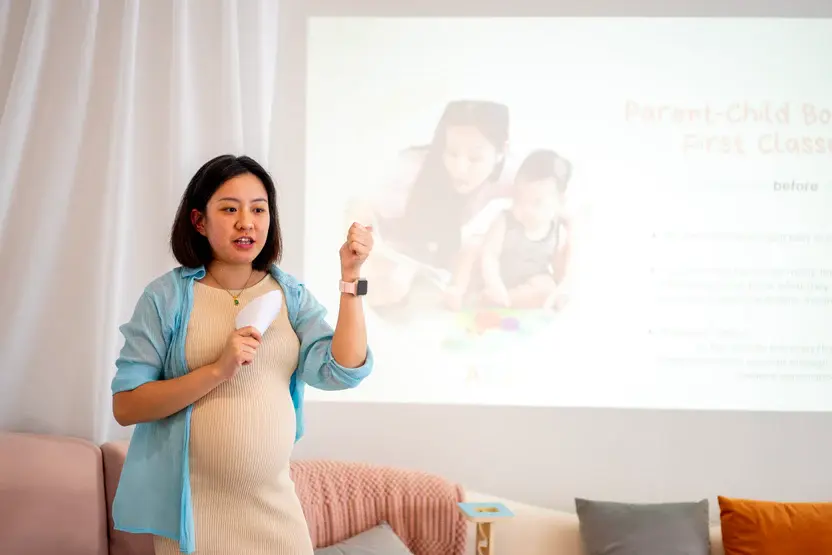
By Christine Lee
Founder of Sunshine Pumpkin
As told to Pregnant and Popped
Parents rarely come to me because their child has nothing to play with.
Usually, the opposite is true.
Their homes are filled with toys, books, low shelves and thoughtfully chosen activities. They have read about Montessori principles, created designated play areas and invested considerable time, energy and money into giving their child the “right” environment.
And yet, their child still calls for them constantly.
They move quickly from one toy to another. They empty everything onto the floor. They appear unable to settle. The parent looks at the carefully arranged space and wonders:
Why isn’t this working?
My answer can be uncomfortable, because it challenges the way many of us have been taught to think about play.
Independent play does not begin with independence. It begins with connection.
A child needs to feel secure before they can confidently explore. They need to know that the adult is available, that mistakes are allowed and that their behaviour will be met with curiosity rather than immediate judgement.
This is why I do not begin by asking which toys a family owns.
I begin by observing.
What is the child repeatedly drawn towards? What are they avoiding? Is the space helping them make a choice, or asking them to process too many possibilities at once? When they return to their parent, are they asking to be entertained - or are they looking for reassurance?
Those questions reveal far more than a list of recommended products ever could.
The playroom is communicating, even when we are not

The environment is not simply the backdrop to a child’s play. It actively shapes what feels possible within that space.
Adults understand this instinctively in our own lives. We know that it is harder to concentrate in a noisy, crowded room. We choose different environments for working, resting, eating and socialising. We adjust the lighting, clear a desk or move to a quieter space when we need to think.
Yet we often expect children to focus in rooms filled with competing colours, sounds, objects and activities.
When a child moves rapidly from one toy to the next, we may say they have a short attention span. When they pull everything from a shelf, we may say they are making a mess. When they return to us rather than choosing something independently, we may decide they are unable to play alone.
But the child may simply be overwhelmed.
Imagine opening your laptop to find more than ten urgent tasks waiting. Your boss is asking for an update, one client wants a presentation changed and another is requesting an immediate meeting. The problem is not necessarily that you cannot focus. The problem is that too much is demanding your attention at once.
A crowded play space can create a similar experience for a young child.
“Less is more” is not an aesthetic rule. It is a way of making the environment easier to read.
Fewer visible materials can make it easier for a child to choose. Clearly defined areas can help them understand whether a space is inviting energetic exploration, quiet reading or imaginative play. Books that can be seen and reached are more likely to be used than books stored inside a closed container.
One family I worked with believed their young daughter simply did not enjoy books. When I asked where the books were, I discovered they were inside a lidded box that required an adult to open it.
We created a small, visible reading corner away from the busier play area.
Later that same day, without anyone prompting her, the child walked over, chose a book, sat down and began turning the pages; her mother had never seen her daughter do that before.
The child had not suddenly learned to enjoy reading; the environment had finally made her interest visible.
Sometimes the environment is hiding what a child can already do

This is one of the most important shifts I help parents make.
Before deciding that a child cannot do something, we need to ask whether the environment is giving them the opportunity to show us that they can.
I once worked with the mother of a six-month-old baby who spent most of her time on a bed. She woke there, fed there and played there. Her mother was concerned that she was becoming frustrated and did not appear able to crawl.
When the baby was given a safe space on a firmer floor, she began to move. Within a short period, her mother reported that she was crawling.
The point is not that changing a room magically creates development. It is that a child’s abilities are expressed through the opportunities available to them.
A baby needs suitable space in which to practise movement. A toddler needs to be able to see and reach the materials they are expected to choose. A child cannot demonstrate independence in an environment that constantly requires adult assistance.
Sometimes we are measuring the child when we should be examining the conditions around them.
Play is not the break between learning
Many parents have absorbed the idea that learning is something formal and measurable, while play is what children do when the learning is finished.
This can create an artificial choice: either I allow my child to play, or I make sure they are progressing.
But in early childhood, play and learning are not competing activities.
Play is a great deal of doing - and doing is how young children learn.

A worksheet might show a child an elephant and a feather and ask which one is heavier. The child may select the elephant because an adult has already taught them the answer.
But when the child lifts, carries, pours, fills and compares real objects, they begin to experience what weight actually means.
That experience is not separate from learning. It is the foundation that makes the later abstract concept meaningful.
The same is true of problem-solving.
Adults are often tempted to step in because we already know what will happen. We know the cup may spill. We know which lid fits. We know the quickest way to complete the task.
Our efficiency can accidentally remove the child’s opportunity to think.
Instead of saying, “Use the jug,” I might say:
“I wonder what else you could try.”
Instead of immediately correcting the way an object is being used, I might ask:
“What have you made?”
I once watched a child join construction cubes together and proudly announce that she had created a selfie stick. She had seen her mother use one during the weekend and recreated that experience through play.
From an adult’s perspective, she was not using the cubes for their intended purpose.
From the child’s perspective, she was observing her world, remembering what she had seen, representing it symbolically and communicating an idea.
That is learning.
The danger of doing the thinking for our children
It is natural to want to help. It is also natural to want to prevent frustration, mess and failure.
But when we constantly provide the solution, children can begin to believe that the adult is the person who knows and they are the person who waits.
Curiosity grows when a child is allowed to wonder.
“What if?”
“What happens when…?”
“How else could we do this?”

These questions do not abandon the child. They offer support without taking ownership of the thinking away from them.
I have taught children who were so worried about getting something wrong that they preferred an adult to complete the task first. They would rather watch someone pour the water than risk spilling it themselves.
Telling that child, “Don’t be scared,” or, “Why won’t you try?” can quickly become another label.
Creating a low-pressure opportunity to experiment communicates something more useful: You can try. Something may go wrong. You will still be safe.
Confidence is not developed by ensuring children always succeed. It is developed by allowing them to discover that an imperfect result is survivable.
Independent play does not mean being left alone
When parents imagine independent play, they often picture a child happily occupied for a long period while the adult works, drinks a coffee or completes another task.
That may eventually be possible. But the image many parents hold is often closer to the capacity of an older child than that of a baby or toddler.
Young children still need adults nearby. They may play for a short period, look back for reassurance and then return to the activity. They may need help beginning before they can continue by themselves.
That is not failed independent play. It is independence developing through connection.
A parent does not have to entertain the child continuously. They can sit nearby, reduce their involvement and remain emotionally available. They can begin the activity together and then allow the child to take over.
The aim is not to make the parent disappear. The aim is for the child to feel secure enough that the parent does not need to direct every moment.
Before calling it a problem, check the expectation
One of the most common statements I hear is:
“My child cannot play independently.”
My next question is usually:
“How long do they play?”
Sometimes the answer is 20 or 30 minutes.

For a two-year-old, that can represent a significant period of engagement. Yet the parent sees only the point at which the child stopped and came back.
We compare children with an imagined standard without always knowing where that standard came from.
We say they are shy, difficult, distracted or unable to focus. We talk about the “terrible twos” as though a whole stage of development is a character flaw. But once a label enters the room, it can begin to shape what the adult notices.
A child reaches for an object and we see disobedience. They seek help and we see dependency. They cry during a transition and we see manipulation.
Observation asks us to pause before creating the story.
What happened immediately before the behaviour? What is the child trying to reach, avoid or communicate? Is the expectation realistic for their age? Could the environment be contributing? Could the child be responding to something they do not yet have the language to explain?
Behaviour does not happen in isolation. It is information.
Children are not miniature adults
Modern parents are often highly informed. They understand that the early years matter. They read about educational approaches, emotional development and respectful parenting.
But knowledge does not remove the pressures of real life.
We are busy. We are rushing. We are thinking about work, meals, appointments and the next thing that needs to happen. In those moments, it is easy to expect children to understand an adult situation they were never part of planning.
The parent wakes knowing that everyone must leave the house at 8.30am. The child wakes knowing only that they are currently playing.
Then, five minutes before leaving, the adult says:
“Stop what you’re doing. Put your shoes on. We’re late.”

From the adult’s perspective, the child is resisting a plan. From the child’s perspective, the plan has just appeared.
This is why preparing children for transitions matters. We can explain what will happen, repeat it and give them time to process the change.
That does not guarantee there will be no tears. Nor does respectful parenting mean that every boundary disappears.
A child can be upset and the answer can still be no. We can acknowledge the feeling without changing the limit:
“You wanted juice this morning. Today we are taking water. I know you don’t like that.”
The lesson is not that the child receives everything they want. The lesson is that disappointment can exist without the relationship becoming unsafe.
Emotional safety is not the absence of boundaries
Sometimes parents worry that acknowledging a child’s emotions means allowing every behaviour. It does not.
If a child throws a toy at someone, we should intervene. We can recognise that they are angry while being clear that hurting another person is not acceptable.
Emotional safety means the child does not have to fear that one difficult moment changes how the parent sees them. It means separating the behaviour from the identity.
There is an important difference between:
“You are naughty.”
and:
“I won’t let you throw that. You are angry, but I will keep everyone safe.”
The boundary remains. The label does not.
The play space must grow with the child
A play environment is not a finished interior design project. It is a living space.
Something that worked a month ago may no longer invite the same engagement. A reading area may need to move. A material may need to be removed and reintroduced later. A child may repeatedly carry an activity somewhere else because that location feels better to them.
Instead of insisting that the child use the space exactly as designed, we can become curious about what their choices are telling us.
I learned this powerfully in the classroom. I had created an area that looked beautiful from an adult’s height, yet few children stayed there. When I physically got down to their level, I understood why. It felt cramped. The proportions and layout did not work from where the children were sitting.
That experience stayed with me. Sometimes the most useful thing a parent can do is get onto the floor and look. What can the child actually see? What can they reach? Does the room feel open or crowded? Are the books visible? Is the activity easy to begin without adult help?
Designing for a child requires more than choosing child-sized furniture. It requires seeing from the child’s position and perspective.
Watch the conversation
In this conversation with Pregnant and Popped, I explore why play is inseparable from learning, how the home environment can shape behaviour and what parents can notice before buying another toy or reorganising an entire room.
We also discuss emotional safety, realistic expectations for independent play and the small changes that can help a child become more confident in their own exploration.
The most important parenting tool may be one you already have
My work is informed by early-childhood theory, years spent teaching children and experience across different educational approaches. But I do not believe one methodology should be treated as the answer for every child. Montessori, Reggio Emilia-inspired practice, thematic learning and inquiry-based education can all offer valuable ideas. The real question is not which label is best.
It is:
What does this particular child need?
Parents already possess the starting point for answering that question.
Observation.
Not observation used to score, compare or diagnose every moment. Observation without immediate judgement.
When we pause long enough to see what a child is already doing, we often discover that they are more capable than we thought. They may not need another activity. They may not need another class. They may not need us to show them the correct answer.
They may need fewer distractions, a more accessible space, a realistic expectation and an adult who is willing to wonder alongside them.
The question is no longer:
“Why won’t my child play properly?”
It becomes:
“What is my child already trying to show me?”
Frequently Asked Questions about Independent Play
What is independent play?
Independent play is when a child explores or engages with an activity without needing an adult to direct every moment.
It does not necessarily mean playing alone. Babies and toddlers may play independently while a parent sits nearby. They may look back, reconnect briefly or ask for occasional support before returning to what they were doing.
The independence lies in the child having growing ownership of the activity.
At what age should a child start playing independently?
There is no single age at which independent play suddenly begins.
Even babies can spend short periods looking, reaching, touching and exploring while a trusted adult remains close. As the child grows, those periods may gradually become longer and more complex.
Expectations should reflect the child’s age, development, temperament and familiarity with the activity. A toddler should not be expected to play in the same way, or for the same length of time, as a six-year-old.
Why won’t my toddler play independently?
A toddler may struggle to play independently because they feel overwhelmed, do not know how to begin or need reassurance from a parent.
The play area may contain too many options. Materials may be difficult to access. The child may also be tired, hungry, overstimulated or adjusting to a change.
Observe what happens before the child returns to you. That moment can reveal whether they are seeking entertainment, practical help, emotional connection or relief from an environment that feels too busy.
How can I encourage independent play?
Begin with connection.
Spend a short time playing alongside your child, then gradually reduce how much you direct. Remain nearby and emotionally available while allowing the child to make more decisions.
Offer a manageable number of accessible materials and pause before solving every problem. Questions such as “What could you try?” can support the child without taking over.
Independent play grows through repeated experiences of feeling both capable and secure.
How long should a toddler play independently?
There is no universal target for independent play.
The length of a play session will vary according to the child’s age, temperament, energy, development and interest in the activity. A short period of concentrated exploration may be more meaningful than a longer period of distracted play.
Focus on gradual development rather than comparing the child with a fixed number of minutes.
Does my child need special toys for independent play?
No. Children can explore and learn using many safe household objects and open-ended materials.
A bowl, wooden spoon, cardboard box, fabric or container may support imagination, movement, sound exploration and problem-solving.
The most useful material is not always the most expensive or heavily marketed. It is the one that gives the child something meaningful to investigate.
All materials should be safe, age-appropriate and offered with suitable supervision.
Can too many toys make it harder for a child to play?
Yes. Too many visible options can make it difficult for a young child to choose and settle.
A child may move quickly between toys, empty shelves or repeatedly ask an adult to select an activity. This can look like poor attention, but the child may be responding to an environment that feels overwhelming.
Reducing and rotating available materials can make choices clearer and renew interest in familiar toys.
How many toys should be available at one time?
There is no ideal number that applies to every child or home.
The space should offer enough variety to invite exploration without making it difficult to choose. Consider presenting a small selection of materials with different possibilities - for example, something for building, something for imaginative play, books and a sensory or fine-motor activity.
Observe how the child responds, then adjust. The child’s behaviour is more useful than a rigid numerical rule.
How should I set up a play area at home?
A useful play area should be calm, accessible and understandable from the child’s perspective.
Place a manageable number of materials where the child can see and reach them. Consider separating quiet activities, such as reading, from louder or more active play.
Get down to the child’s height and look at the room. Check what they can see, what they can access independently and whether the space feels inviting rather than crowded.
The goal is not to create a perfect playroom. It is to create a space the child can confidently use.
Do I need a separate playroom?
No. Independent play does not require a dedicated room.
A small corner of a living room, bedroom or shared family space can work well when it is clearly arranged and accessible.
A defined area can help the child understand what is available, but it should still fit naturally into family life. The quality and clarity of the space matter more than its size.
Why does my child keep asking me to play?
Young children often return to a parent because the parent is their secure base.
They may want interaction, but they may also need reassurance, help beginning an activity or support managing frustration.
Responding does not automatically make a child dependent. Connection helps create the security from which independence can gradually grow.
Parents can acknowledge the child, offer brief support and then encourage them to continue.
Is independent play the same as leaving a child alone?
No.
Independent play means the child has some control over the activity. It does not mean they should be physically isolated or left without appropriate supervision.
For babies and toddlers, an adult may remain in the same room, complete another task or simply observe. The adult is available but does not control every part of the play.
Should I show my child the correct way to use a toy?
Not always.
Demonstration can be helpful, particularly when safety or a specific skill is involved. But children also learn by experimenting and using materials in unexpected ways.
Before correcting them, observe what they are trying to do. Ask what they have made or what they think might happen.
An unconventional use may reveal imagination, memory and problem-solving rather than misunderstanding.
What should I do when my child becomes frustrated during play?
Pause before fixing the problem.
Acknowledge that the task is difficult and offer enough support to help the child continue thinking. You might say:
“That did not work the way you expected. What else could we try?”
Step in when safety is involved or the child is too overwhelmed to continue. The aim is not to withhold help, but to make sure support does not replace the child’s opportunity to think.
Is play really a form of learning?
Yes. Through play, children explore movement, language, relationships, cause and effect, imagination, problem-solving and physical properties such as size, balance and weight.
Play gives young children direct experiences before they are expected to understand abstract ideas.
Formal activities and worksheets may have a place later, but they do not replace the learning that happens through touching, moving, experimenting and doing.
What is the parent’s role in play?
A parent’s role is not always to entertain, direct or provide answers.
Often, the most valuable role is to create a safe environment, offer appropriate materials and observe.
Parents can support play by following the child’s interest, asking open questions, allowing time for experimentation and stepping in when genuine help or safety guidance is needed.
Can play help children become more confident?
Play can create opportunities for children to make decisions, solve problems and recover when something does not work.
When adults allow children to try without immediately correcting them, children begin to experience themselves as capable.
Confidence develops not because every attempt succeeds, but because the child learns that they can continue after difficulty.
What is the relationship between emotional safety and independent play?
Children are more willing to explore when they feel secure in their relationship with the adult caring for them.
Emotional safety does not mean removing every boundary or preventing frustration. It means that mistakes, disappointment and strong feelings do not threaten the relationship.
A child who trusts that support remains available can gradually move further into independent exploration.
Can boundaries and gentle parenting exist together?
Yes.
Gentle or respectful parenting does not require adults to accept unsafe or harmful behaviour. Parents can acknowledge a child’s feeling while maintaining a clear boundary.
For example:
“You are angry, but I will not let you throw the toy.”
The child’s emotion is recognised. The limit remains firm. The behaviour is corrected without labelling the child as bad.
When should I change my child’s play space?
Change the space when the child’s behaviour suggests it is no longer working for them.
They may stop visiting an area, repeatedly move materials elsewhere or appear unable to choose. These can be signs that the layout, selection or location needs adjusting.
A play environment should evolve with the child’s development and interests. It does not need to remain fixed simply because it was originally designed in a particular way.

About Christine
Christine is the founder (along with her husband Isaac) of Sunshine Pumpkin, an early-childhood educator and mother who helps families understand the connection between play, environment, emotional safety and child development.
Drawing on more than seven years of experience working with young children across different educational settings, Christine supports parents to look beyond labels and recognise what their child’s behaviour may be communicating.
Her work focuses on helping families create intentional play environments, deepen parent-child connection and nurture curious, confident children. Learn more about Sunhine Pumpkin's services here
About this article
This article was created from Christine’s recorded conversations with Pregnant and Popped, supported by her original voice notes and a follow-up editorial discussion. It has been shaped for clarity and readability while preserving Christine’s ideas, experiences and intended meaning.
Disclaimer
Thought Leadership articles on Pregnant and Popped are created from interviews, recordings and conversations with professionals, business owners and other contributors. They are intended to share experience, professional perspectives and general information, and may be created in collaboration with the featured provider as part of a paid thought leadership service.
The views expressed belong to the featured contributor and do not necessarily represent the views of Pregnant and Popped or Empowa. Publication does not constitute verification of every statement, endorsement of a particular provider, product, service or method, or a guarantee of results.
Pregnancy, birth, postnatal recovery, infant care and parenting experiences vary. Content is provided for educational and informational purposes only and should not be treated as medical, legal, financial or other professional advice. Readers should seek personalised guidance from their healthcare provider or another suitably qualified professional before making decisions based on the information provided.
While we take reasonable care when preparing and publishing articles, information may become outdated, and we cannot guarantee that all content is complete, accurate or suitable for every person or situation. Pregnant and Popped and Empowa accept no responsibility for decisions made or actions taken solely in reliance on the information provided.


Comments