

THE PERMISSION TO STEP AWAY: Why Child-Free Time Can Be Part of Good Parenting
In conversation with Calista (Founder of The Fun Cove & Early Childhood Educator)
Featuring research insights on parental burnout, responsive caregiving, and early childhood development.
Key Takeaways & Core Insights
Presence vs. Proximity: Good parenting is defined by emotional availability, patience, and quality of attention, not merely physical co-presence or hours spent beside a child.
The Invisible Mental Load: Cognitive household labor ("open tabs") continuously depletes caregiver capacity, directly impacting the emotional atmosphere young children experience.
Responsive Care Requires Support: Early childhood research from WHO, UNICEF, and Harvard confirms that responsive caregiving depends directly on the caregiver’s own mental health and social support systems.
Educator-Led Flexible Care: On-demand care options like The Fun Cove in Singapore provide functional, ECDA-certified support for modern families during nights, weekends, and critical transitions like labor and birth.
Looking for Something Specific?
If you have come to this article with a particular question, you can jump straight to the section most relevant to you:
Watch: Calista on Why Child-Free Time Makes Better Parents
For many parents, the hardest part of arranging childcare support is not the booking, the packing of the bag, the handover instructions or even the possibility that a child may cry at drop-off. Often, the hardest part begins much earlier, in the private moment when a parent first admits that they need help.
That moment can carry a very particular kind of guilt.
Should I be able to manage this myself? Am I being selfish? Will my child feel unsettled? What kind of parent am I if I need this time away?
For Calista, founder of The Fun Cove, who holds a Diploma in Early Childhood Education, a Bachelor of Counselling, and over 11 years of experience in the early childhood sector (including as a teacher, deputy centre leader, and vice principal), this guilt is one of the most unhelpful misunderstandings in modern parenting. The Fun Cove describes itself as Singapore’s first and only 24/7 on-demand babysitting centre, serving children aged 1 month to 6 years, and filling a childcare gap for families when preschools are closed, weekends are uncovered or dependable support is unavailable.
But in conversation, Calista’s message is not simply about offering parents a place to leave their children for a few hours. It is about how families function when parents are expected to be constantly available, emotionally patient, developmentally responsive and practically organised - often without the support systems that make such parenting sustainable.
The research context matters here, because Calista’s point sits within a broader early childhood understanding: young children need responsive, emotionally available care, and caregivers need support in order to provide it. The World Health Organization, UNICEF and the World Bank Group’s Nurturing Care Framework identifies responsive caregiving as one of the central components of early childhood development, alongside good health, adequate nutrition, safety and security, and opportunities for early learning. UNICEF’s Caring for the Caregiver materials go further in naming the adult side of the equation, recognising that caregivers’ own mental health and wellbeing affect their ability to provide nurturing care.
That shifts the conversation. The question is not whether parents are “allowed” to need rest, space or practical help. The better question is: what conditions allow parents to provide the kind of calm, attentive and responsive care that children need?
Calista’s argument is not that parents should spend less time with their children. It is that good parenting cannot be measured only by the number of hours a parent is physically beside a child. It also matters which version of the parent the child receives during those hours. A parent may spend an entire weekend with a child and still be distracted, hurried, irritable or emotionally depleted. The child may have had many hours of proximity, but very little of the parent’s full attention, patience or delight.
This is the distinction Calista keeps returning to: presence is not the same as proximity.
She describes the mental load of parenting as having too many “open tabs” in the mind. It is a simple image, but it captures something many parents recognise immediately. While sitting beside a child, a parent may also be thinking about groceries, nap timings, work messages, weekend plans, school forms, household supplies, birthday presents, laundry, meals, appointments and the next day’s schedule. Nothing dramatic is happening from the outside. The parent appears to be there. But internally, the family operating system is still running.
Calista’s point is not that parents need to justify time away from their children. It is that brief, trusted periods of child-free time can help parents return with more softness, energy and emotional availability. In that sense, The Fun Cove is not simply a childcare convenience. It sits within a wider conversation about parental wellbeing, the invisible work of family life, children’s growing independence, and the practical support modern families need when their usual support systems are stretched or absent.
Why Is Parental Capacity More Important Than "Me Time"?
Conversations about parents taking breaks are often flattened into the language of “me time” or “self-care”. That language can be useful, but it can also make the issue sound lighter than it is. Calista is not talking about a parent occasionally wanting something nice for themselves, although there is nothing wrong with that. She is talking about capacity: the emotional, physical and mental resources a parent needs in order to respond to a child with patience and warmth.
This is especially important because many parents, and particularly many mothers, are used to putting their own needs last. Calista has seen mothers become “a hundred percent invested” in their children, not because they are doing anything wrong, but because love and responsibility can quietly expand until there is very little room left for the mother as a person. Hair appointments, meals with friends, exercise, rest, quiet time, adult conversation and couple connection can start to feel optional, indulgent or impossible. Over time, the issue is not simply that the mother is tired. It is that she may begin to disappear into the management of everyone else’s needs.
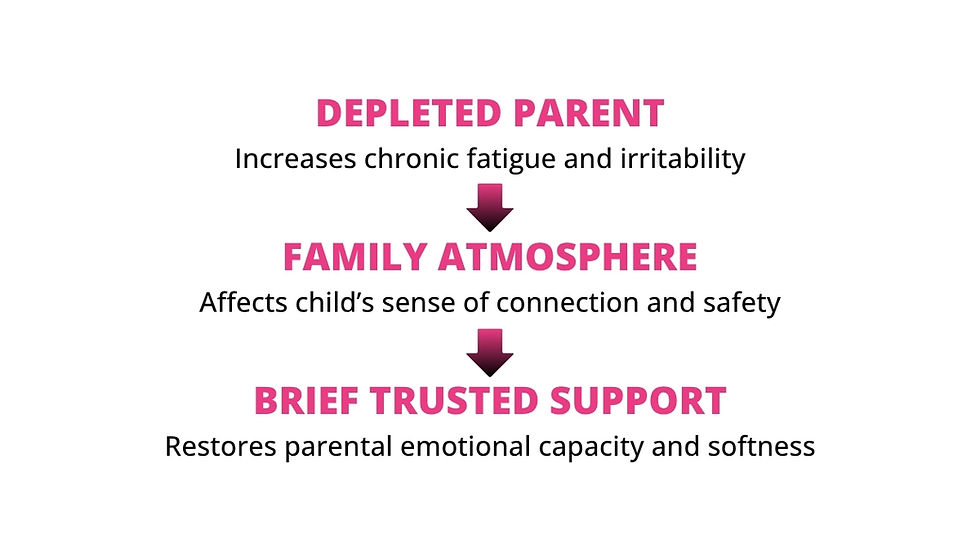
This matters because children do not only receive the visible care a parent provides. They also live inside the emotional atmosphere created by the adults around them. A parent may be doing all the right practical things - feeding, bathing, school runs, activities, bedtime, errands - while internally running on very little. When that depletion becomes chronic, it can affect how a parent speaks, how quickly they become frustrated, how much delight they can access, and how available they are for the small, repetitive moments through which young children experience connection.
Parental burnout research helps give language to this. Parental burnout is not ordinary tiredness. Researchers describe it as a parenting-specific condition characterised by overwhelming exhaustion in the parental role, emotional distancing from one’s children and a sense of reduced parental efficacy. A large 42-country study of more than 17,000 parents identified parental burnout as a cross-cultural issue with consequences for both parents and children. These findings do not mean every exhausted parent is experiencing burnout, nor should they be used to pathologise normal parenting fatigue. But they do support Calista’s practical concern: when parents are persistently depleted and unsupported, the quality of care can change.
That is why a short period of support can matter. Not because a parent needs to escape the child, but because the parent may need time to recover enough emotional space to return well. Calista often frames this in very concrete terms: if a two-hour break allows the next ten hours with a child to be calmer, more connected and less rushed, that time away is not separate from good parenting. It may be one of the conditions that makes good parenting easier to sustain.
How Does the Mental Load of Parenting Affect Presence?
One of Calista’s strongest images is the idea of mental “tabs” left open. It works because it does not dramatise parenting; it describes the ordinary. Modern family life is full of small, constant forms of noticing and remembering.
Who is running out of diapers?
Which snacks are finished?
What time is the class?
Has the form been submitted?
Did the child nap?
Is there enough milk?
Who needs new shoes?
What is the plan for dinner?
What will happen if the baby wakes early, the toddler refuses shoes, the helper is off, the grandparent is unwell or the meeting overruns?
This kind of work is often invisible because it happens in the mind before anything happens in the world. It is not just the doing of tasks, but the anticipating, sequencing and holding of responsibility. A parent carrying this load may look as though they are simply standing in the kitchen, sitting on the floor or walking through the supermarket. Internally, they are running a complex household operating system.
Research increasingly recognises this cognitive dimension of family work. A 2024 study on cognitive household labour found that this mental labour is highly gendered and is associated with women’s depression, stress, burnout, overall mental health and relationship functioning. Sociological research on the cognitive dimension of household labour has also described how anticipating needs, identifying options, making decisions and monitoring outcomes form part of the invisible work of managing family life.
Calista’s “open tabs” language gives that research a lived shape. It explains why a parent can be physically with a child and still not feel truly present. The child asks to play, and the parent wants to respond warmly, but the parent’s mind is still with the grocery list, the unanswered message, the baby’s nap, the older child’s schedule, the work deadline and the weekend errands. The parent may not need time away because they dislike parenting. They may need time away because parenting has become the place where every unfinished task follows them.
This also helps explain why the issue is not solved simply by telling parents to “be more present”. Presence is not only a mindset. It is affected by sleep, support, stress, time pressure, practical demands and the amount of invisible labour one adult is carrying. When those pressures are reduced, even briefly, parents may find it easier to offer the kind of attention they wanted to give in the first place.
Does More Time With Children Mean Better Parenting?
Calista is careful not to suggest that time with children does not matter. It does. Young children need dependable, loving adults. They need routines, closeness, play, touch, conversation and repeated experiences of being known. But she challenges the assumption that more hours automatically mean better parenting.
This distinction is important. A parent may spend an entire Saturday with a child, but if the day is dominated by errands, rushing, irritation and repeated instructions to “hurry up”, the child may not experience that time as connection. They may experience it as pressure. Conversely, a parent who has had a short period to rest, run errands, exercise or reconnect with their partner may be able to return with more patience and attention.

Research on parent-child time also distinguishes between quantity and quality. Studies examining children’s wellbeing and parental involvement have noted that the quality of parent-child interaction matters, not only the amount of time spent together. Research on quality time and children’s flourishing similarly suggests that meaningful, engaged time with parents is associated with better child flourishing, particularly when it includes responsive, relational interaction rather than mere co-presence.
This supports one of Calista’s clearest points: the aim is not to reduce the parent-child relationship to clocked hours. The aim is to notice what happens inside those hours. Is the parent able to respond? Is the child being rushed through every moment? Is the adult emotionally available? Is the time together relational, or is the child simply accompanying the parent through adult obligations?

This becomes especially visible in the toddler years. Calista pushes back against the phrase “terrible twos” because she sees toddler resistance as part of a child’s growing autonomy, not simply bad behaviour. A toddler who wants to put on their own shoes, pour water, climb, choose, build or try again is often practising competence. But toddlers move slowly, and adult life often moves quickly. When a parent is already overloaded, these moments can become battlegrounds rather than opportunities for learning.
Developmental theory has long recognised the importance of autonomy in the toddler period. Erik Erikson’s psychosocial framework describes early childhood as a stage in which children begin developing independence and a sense of personal agency through everyday attempts at doing things for themselves. Calista’s practical observation sits comfortably alongside this: when parents are always rushed, children lose some of the space they need to practise, and parents lose some of the patience needed to let them.
The point is not that parents must wait patiently through every shoe, spoon, zip or cup. No parent can do that all the time. The point is that a family system with no margin makes patience harder. Support creates margin. Margin makes responsive parenting more possible.
Is Delegating Childcare the Same as Outsourcing Love?
One of the most emotionally loaded phrases around childcare is “outsourcing”. It suggests that if a parent asks someone else to care for their child, they are handing over something they should be doing themselves. Calista’s reframing is simple but significant: delegating care for a short period is not the same as delegating love.
A parent can be deeply devoted and still need support. A child can be securely loved and still spend time with a trusted caregiver. A family can be close without requiring one parent, often the mother, to be endlessly available.
This matters because the guilt around childcare often turns a practical need into a moral question. A parent may need to run errands efficiently, attend an appointment, sleep after a difficult night, spend time with a partner, return to work, exercise, or simply sit quietly for a while. These are not failures of devotion. They are ordinary human needs inside a demanding caregiving role.
UNICEF’s Global Parenting Support Framework is helpful here because it moves the issue away from private guilt and into the wider ecology of family support. The framework argues that every family should have access to the support needed to raise children in safe, nurturing and protective environments. In other words, parenting support is not a luxury add-on to family life. It is part of the conditions that allow families to function.
This is especially relevant in Singapore, where support arrangements vary widely. Some families have helpers, grandparents or extended family nearby. Others do not. Some grandparents are overseas, still working, elderly, unwell or unavailable. Some families may have a helper who can provide basic care, while still wanting trained, developmentally informed engagement for babies and toddlers. Calista’s question is therefore not simply, “Is there an adult available?” It is also, “What kind of care does this child need in this moment, and what kind of support does this family need to function well?”
That distinction matters. Basic caregiving keeps a child safe, fed and clean. Meaningful engagement goes further. It notices age, temperament, developmental stage, emotional cues and the child’s need for play, language, autonomy and responsive interaction. Both forms of care have value, but they are not identical.
What Makes Educator-Led Care Different From Ordinary Babysitting?
If the article’s central argument is that children need responsive care, then the quality of the caregiver matters. It is not enough for an adult simply to be present in the room. Babies and young children communicate through cues, rhythms, preferences, distress signals, play, repetition and behaviour. A caregiver who understands early development is more likely to recognise what a child is trying to communicate, especially in an unfamiliar environment.
This is where Calista’s background becomes relevant. Before founding The Fun Cove, she spent around 11 years in the early childhood sector, including experience as a teacher, deputy centre leader and vice principal. Pregnant and Popped’s provider directory also lists her Diploma in Early Childhood Education, Bachelor of Counselling and certification in Infant and Child First Aid. That background shapes the way she speaks about childcare: not only as watching children, but as understanding them.

The Fun Cove’s website describes care for children aged 1 month to 6 years, age-appropriate activities, ECDA trained professionals, no screen time provided, healthy meals aligned to Health Promotion Board guidance, and daily photo updates for parents. These details are not just operational. They point to the kind of reassurance many parents are looking for when they ask the questions beneath the questions: Will my child be safe? Will they be understood? Will someone know what to do if they cry? Will they be meaningfully engaged, not just occupied?
Early childhood research gives weight to the importance of responsive adult-child interaction. Harvard’s Center on the Developing Child describes “serve and return” interactions - the back-and-forth exchanges between a young child and a caring adult - as foundational to healthy brain architecture. The CDC’s developmental guidance similarly encourages caregivers to talk, sing, read and respond during ordinary routines, reminding us that early learning often happens through everyday interaction rather than formal instruction.

These sources do not suggest that infants and toddlers need constant adult-led activity. They suggest that ordinary caregiving is full of developmental opportunities when the adult is attentive. A baby looks, coos or reaches, and the caregiver responds. A toddler struggles to build something, and the adult waits, observes or asks a question rather than immediately fixing it. A child arrives in an unfamiliar environment, and the caregiver uses familiar interes
ts, songs or play themes to create a bridge into the new space.
This is where Calista’s educator lens matters. Meaningful care is often subtle. It may not look impressive from the outside. But it is present in how an adult reads a child’s cue, how they prepare the environment, how they support autonomy, how they respond to distress, and how they decide when to step in or give space.
How Can Parents Help Children Manage Separation Anxiety?
For many parents, the emotional difficulty of childcare begins at separation. Calista notices that parents do not always ask their real question directly. They may not say, “Will my child cry?” or “Will my child feel abandoned?” Instead, they ask practical questions: How do you settle them? What happens if they are upset? How will you make them comfortable? How will you know what they like?
Beneath those questions is usually a deeper concern: Will my child feel safe without me?
Calista does not dismiss that concern. Separation can be emotionally charged for both parent and child. Her view is not that parents should ignore crying or push children into independence before they are ready. Rather, she sees separation as something children can learn gradually when it is predictable, supported and followed by reunion.

This aligns with paediatric guidance. HealthyChildren.org, from the American Academy of Pediatrics, describes separation anxiety as a normal developmental experience and recommends preparation, consistent routines, full attention at goodbye, brief confident departures and keeping the promise to return. Its guidance on childcare drop-off also notes that separation anxiety can be especially difficult in the toddler period and that consistency can help children adjust.
The practical point is not that early drop-offs will prevent separation anxiety, or that every child will adapt at the same pace. Temperament, age, family patterns and previous experiences all matter. Some children need more time. Some separations are harder than others. Parents should seek professional guidance if a child’s distress is extreme, prolonged, worsening or otherwise concerning.

What Calista offers is a gentler pathway: start small where possible, prepare the child, make the goodbye predictable, allow the child to build familiarity, and give both parent and child repeated experiences of leaving and returning. Flexible care matters because it avoids making separation all or nothing. A child does not have to move immediately from constant parental presence to a full day in a new environment. They can begin with a shorter session, then build slowly.
This is especially relevant before preschool or infant care. Calista often explains it in adult terms: if an adult started a new job and had to spend twelve hours in an unfamiliar place on the first day, with new people, routines and expectations, they would likely feel overwhelmed too. Children are no different. Their world is smaller, their language is still developing, and their sense of time is limited. Repeated, supported separation can help them learn the pattern: I arrive, I am cared for, I play, I eat, I rest, and my parent comes back.
Why Do Modern Families Need a "Missing Village"?
The phrase “it takes a village” is used often, but many families do not actually have one. This is not simply an emotional statement. It is a practical reality. Parents may be raising young children while working full-time, without extended family nearby, with grandparents who are unwell or unavailable, or with support that covers basic care but not the particular need in front of them.
This is where the larger argument about caregiver support becomes very concrete. Parents do not only need encouragement or permission to rest. They need actual, dependable options at the moments when family life becomes difficult to manage alone. Sometimes that moment is ordinary: an appointment, an errand, a work commitment, a school closure, a weekend without help. Sometimes it is more emotionally loaded: the end of confinement support, a stretch of disrupted sleep, or the arrival of a new baby.
Calista sees this range in the families who come to The Fun Cove. Some need two hours to run errands without rushing a child through every stop. Some need a place for their child while they attend an appointment or a child-free event. Some need overnight care because they are exhausted after a difficult stretch with a baby. Some need support after confinement care ends and they suddenly find themselves alone with a newborn, fragmented sleep and uncertainty about soothing, feeding or settling.
These examples should not feel like separate problems. They are different versions of the same issue: families need dependable support at the moments life actually happens. Not only during office hours. Not only when preschools are open. Not only when grandparents happen to be free. Not only when the need is planned neatly in advance.
This is also why The Fun Cove’s model extends beyond occasional babysitting. Flexible care becomes most meaningful when it meets the shape of real family life, including the moments parents cannot fully predict.
How Do Families Arrange Childcare During Second-Baby Labor?
One of the clearest examples is birth and labour cover for families expecting a second or subsequent baby. When labour begins, the older child still needs care. That need may arise in the middle of the night, during a weekend, or at a time when relatives, friends or helpers are unavailable. Labour may last a few hours or much longer, and parents may not be able to plan exactly when support will be needed or how long it will be required.
For families with a reliable village, this may be manageable. A grandparent comes over, a sibling steps in, or a trusted friend is on standby. But for many families, especially those without nearby or available extended support, this can become a major source of stress at precisely the moment when parents need to focus on birth.
Seen in this context, labour cover is not a random add-on to the conversation. It is one of the clearest examples of the support gap Calista is trying to address. The question is not simply, “Who can watch my child?” It is, “Can I enter labour knowing my older child is safe, cared for and emotionally supported?”
Reliable care for the older child allows the birthing parent and partner to focus on the birth rather than splitting attention between labour and childcare uncertainty. It also protects the older child from being treated as a logistical problem in a moment of major family transition.
This is where The Fun Cove’s flexibility becomes practical rather than abstract. The service is built around the reality that family needs do not always happen at convenient times. They arise after preschool hours, on weekends, overnight, during public holidays, after confinement care ends and, sometimes, when labour begins.
Why Does the Couple Relationship Matter for Family Systems?
Calista also speaks about the couple relationship, but this belongs within the same wider argument rather than as a separate theme. If the parent-child relationship is shaped by the wellbeing of the adults, then the relationship between adults matters too. Many couples find that, after children, conversation becomes increasingly functional: what needs to be bought, who is picking up, what time the child slept, what is running low, where they are going on the weekend.
That shift is understandable. Young children create real practical demands. But when all adult connection becomes logistics, the family system loses something.
Child-free time does not have to mean an elaborate date night. Sometimes it is a meal nearby. Sometimes it is exercise. Sometimes it is two hours to complete errands without rushing. Sometimes it is simply a conversation in which both adults remember they are not only co-managers of a household, but partners.
This is not separate from parenting. It is part of the emotional infrastructure around the child. When adults have space to reconnect, regulate and feel human again, the family atmosphere changes. The child does not need perfect parents or a perfect couple relationship. But children do benefit from adults who are less depleted, less resentful and more able to meet them with steadiness.
What Calista Wants Parents to Hear
At the heart of Calista’s message is not a command, but a permission.
Permission to need help.
Permission to want a short break.
Permission to say, “I love my child, and I also need time to myself.”
Permission to believe that a child crying at drop-off does not automatically mean the parent has done something wrong.
Permission to see trusted childcare support as part of a healthy family system, not evidence of failure.
This message should not be turned into a blanket rule. Not every child is the same. Not every family has the same resources. Not every parent can access paid care. Not every separation is appropriate in the same way. But the belief underneath Calista’s work is clear: a parent does not have to be with a child every waking moment to prove love.
A child can be deeply loved and cared for by another trusted adult. A parent can step away for a while and return more available, more regulated and more themselves. A family can be close and still use support.
Sometimes the most loving choice is not to keep pushing through on empty. Sometimes it is to build the support that allows the parent to come back with more of themselves intact.
Frequently Asked Questions (FAQ)
Is it selfish to want time away from your child?
Wanting time away from your child is not automatically selfish. Parents are human beings with emotional, physical and mental limits. Calista’s view is that short periods of trusted childcare can help parents return with more patience and presence. This aligns with early childhood frameworks that recognise caregivers need support in order to provide responsive and nurturing care.
Does using babysitting or flexible childcare mean I am outsourcing parenting?
No. Delegating care for a few hours is not the same as outsourcing the parent-child relationship. A child can be securely loved by their parents and still spend time with a trusted caregiver. Calista encourages parents to see support as part of family wellbeing, not as evidence that they are less committed.
Will my child be harmed if they cry at drop-off?
Crying at separation can be developmentally normal, especially for babies and toddlers. It does not automatically mean the child is unsafe or that the parent has made the wrong choice. Paediatric guidance recommends preparation, predictable routines, full attention at goodbye and confident departures when supporting children through separation anxiety. Parents should seek professional advice if distress is extreme, prolonged, worsening or accompanied by other concerning symptoms.
How can parents help children become more comfortable being away from them?
Calista often recommends starting small where possible: a short drop-off, then gradually increasing the time as the child and parent become more confident. A familiar goodbye routine, clear reassurance that the parent will return, and a trusted caregiver can support the transition. The goal is not to force independence, but to help children experience separation and reunion in a predictable, supported way.
Why does quality of time matter as much as quantity of time?
Children need responsive and emotionally available caregivers. A parent may spend many hours with a child but be distracted, rushed or irritable because of exhaustion and mental load. Research on parent-child time increasingly distinguishes between the quantity of time and the quality of interaction within that time. Calista’s point is that children benefit not only from parental presence, but from parents who are actually available within that presence.
What is mental load in parenting?
Mental load refers to the invisible cognitive work of managing family life: planning, remembering, anticipating needs, tracking supplies, organising schedules and holding responsibility for what comes next. Research on cognitive household labour has linked this kind of invisible work with women’s stress, burnout, mental health and relationship functioning. Calista’s “open tabs” analogy is a practical way of describing this cognitive burden.
What makes educator-led care different from ordinary babysitting?
Educator-led care is shaped by knowledge of child development, routines, emotional regulation, age-appropriate engagement and developmental milestones. At The Fun Cove, Calista’s early childhood background informs how babies are engaged, how toddlers are supported, and how caregivers decide when to step in, when to observe and when to encourage a child’s independence.
Can flexible childcare help before preschool or infant care?
For some families, yes. Calista sees flexible sessions as a gentler way for children to practise being away from parents before a longer childcare or preschool transition. A child might begin with a shorter session and gradually build up. This does not guarantee that every child will avoid separation anxiety, but it can give some children repeated experiences of being cared for safely and then reunited with their parents.
Why might parents use childcare even if they have a helper or grandparents?
Having someone available is not always the same as having the right support for a specific need. A helper or grandparent may provide loving basic caregiving, but some parents may also want trained developmental engagement, flexible drop-off hours, overnight care, or support during specific moments such as labour or post-confinement overwhelm.
What should parents consider before using flexible childcare?
Parents should consider the child’s age, temperament, routines, feeding and sleep needs, allergies, the caregiver’s training, the environment, safety practices, communication style, and how the provider handles distress. For babies and toddlers, it can be especially helpful to ask how the caregiver settles children, communicates with parents, supports routines and responds when a child cries.
About the Expert

Calista is the founder of The Fun Cove, a flexible, educator-led play and care space in Singapore that supports both children and parents. The Fun Cove provides 24/7 on-demand babysitting and flexible drop-off care for children aged 1 month to 6 years, with age-appropriate engagement, developmental support and practical family care.
Before founding The Fun Cove, Calista spent around 11 years in the early childhood sector, including experience as a teacher, deputy centre leader and vice principal. Her work combines professional early childhood training (Diploma in Early Childhood Education, Bachelor of Counselling, and Infant/Child First Aid certification) with lived experience as a mother, giving her a practical understanding of both sides of the drop-off: the parent who feels guilty leaving, and the child who needs to feel safe while they are away.
Website: https://www.thefuncove.com/
Instagram: @thefuncovesg
About this article
This article was created from Calista’s recorded conversations with Pregnant and Popped, supported by her original voice notes and a follow-up editorial discussion. It has been shaped for clarity and readability while preserving Calista’s ideas, experiences and intended meaning.
References and Footnotes
The Fun Cove. (2026). 24/7 On Demand Babysitting Centre, accessed 25 September 2026. https://www.thefuncove.com/
World Health Organization, UNICEF, World Bank Group, ECDAN, PMNCH and Every Woman Every Child. (2018). Nurturing Care for Early Childhood Development: A Framework for Helping Children Survive and Thrive to Transform Health and Human Potential, World Health Organization. https://www.who.int/publications/i/item/9789241514064
UNICEF. (2026). Caring for the Caregiver, developed with the University of the Witwatersrand and the World Health Organization, accessed 25 September 2026. https://www.unicef.org/documents/caring-caregiver
Mikolajczak, Moïra, James J. Gross and Isabelle Roskam. (2019). “Parental Burnout: What Is It, and Why Does It Matter?”, Clinical Psychological Science. https://journals.sagepub.com/doi/full/10.1177/2167702619858430
Roskam, Isabelle, Moïra Mikolajczak and the International Investigation of Parental Burnout Consortium. (2021). “Parental Burnout Around the Globe: A 42-Country Study,” Affective Science. https://pubmed.ncbi.nlm.nih.gov/33758826/
Aviv, Tamar, Darby Saxbe, and colleagues. (2024). “Cognitive household labor: gender disparities and consequences for maternal mental health and wellbeing,” Archives of Women’s Mental Health. https://pmc.ncbi.nlm.nih.gov/articles/PMC11761833/
Daminger, Allison. (2019). “The Cognitive Dimension of Household Labor,” American Sociological Review. https://journals.sagepub.com/doi/10.1177/0003122419859007
Li, Dongmei, Wei Zhou, and colleagues. (2023). “The effect of the time parents spend with children on children’s well-being,” Frontiers in Psychology. https://pmc.ncbi.nlm.nih.gov/articles/PMC10106685/
Cui, Naixue, and colleagues. (2023). “The association between parent-child quality time and children’s flourishing level,” Journal of Pediatric Nursing. https://pubmed.ncbi.nlm.nih.gov/37775429/
Orenstein, George A., and Lindsay Lewis. (2023). “Erikson’s Stages of Psychosocial Development,” StatPearls, National Library of Medicine. https://www.ncbi.nlm.nih.gov/books/NBK556096/
UNICEF. (2025). Global Parenting Support Framework, UNICEF. https://www.unicef.org/documents/global-parenting-support-framework
Pregnant and Popped. (2026). “The Fun Cove,” Provider Directory, accessed 25 September 2026. https://www.pregnantandpopped.com/provider/the-fun-cove
Center on the Developing Child at Harvard University. (2026). “Serve and Return: Back-and-forth exchanges,” accessed 25 September 2026. https://developingchild.harvard.edu/key-concept/serve-and-return/
Centers for Disease Control and Prevention. (2026). “Milestones by 1 Year,” CDC Learn the Signs. Act Early., accessed 25 September 2026. https://www.cdc.gov/act-early/milestones/1-year.html
Swanson, Wendy Sue. (2026). “How to Ease Your Child’s Separation Anxiety,” HealthyChildren.org, American Academy of Pediatrics, accessed 25 September 2026. https://www.healthychildren.org/English/ages-stages/toddler/Pages/Soothing-Your-Childs-Separation-Anxiety.aspx
American Academy of Pediatrics. (2026). “Making Baby Drop Off at Child Care Easier,” HealthyChildren.org, accessed 25 September 2026. https://www.healthychildren.org/English/family-life/work-and-child-care/Pages/making-baby-drop-off-at-child-care-easier.aspx
Disclaimer
Thought Leadership articles on Pregnant and Popped are created from interviews, recordings and conversations with professionals, business owners and other contributors. They are intended to share experience, professional perspectives and general information, and may be created in collaboration with the featured provider as part of a paid thought leadership service.
The views expressed belong to the featured contributor and do not necessarily represent the views of Pregnant and Popped or Empowa. Publication does not constitute verification of every statement, endorsement of a particular provider, product, service or method, or a guarantee of results.
Pregnancy, birth, postnatal recovery, infant care and parenting experiences vary. Content is provided for educational and informational purposes only and should not be treated as medical, legal, financial or other professional advice. Readers should seek personalised guidance from their healthcare provider or another suitably qualified professional before making decisions based on the information provided.
While we take reasonable care when preparing and publishing articles, information may become outdated, and we cannot guarantee that all content is complete, accurate or suitable for every person or situation. Pregnant and Popped and Empowa accept no responsibility for decisions made or actions taken solely in reliance on the information provided.


Comments